
Study II - Coffee Tint Transparency

Method
Clear casting resin was tinted using a coffee pigment at progressively reduced concentrations.
Small sample pours were prepared at measured dilution ratios ranging from strong tint to extremely light transparency.
Each sample was allowed to cure fully before being examined under both direct and diffused light.
The aim was to observe how colour density affects:
• Light transmission
• Perceived depth within the resin
• Interaction with surrounding timber grain
Observation
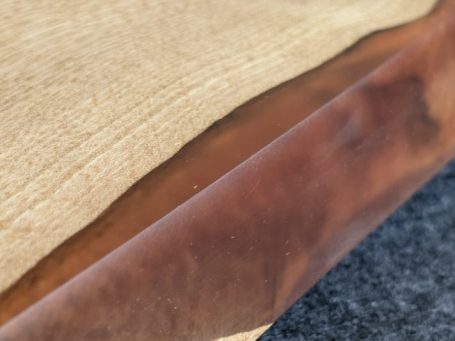
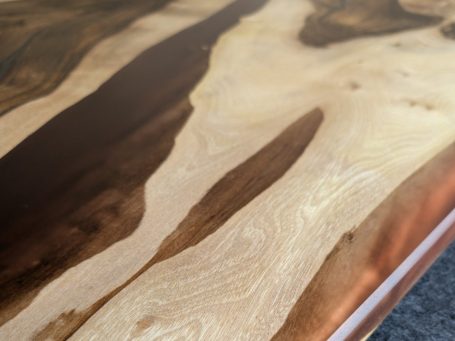
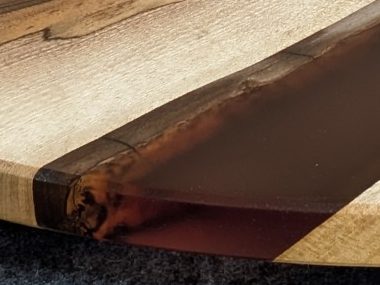
At higher concentrations the resin begins to behave as a surface colour, visually separating itself from the timber.
As dilution increases, the resin transitions from opaque colour to a translucent medium.
At lower concentrations the tint becomes almost atmospheric — introducing warmth without obscuring structure.
In this state the resin behaves less like an insert and more like a continuation of the timber's natural shadow.
Application
Most INSIGNI pieces employ tint levels at the lighter end of this range.
This preserves the natural hierarchy of materials: timber remains the dominant form, while resin acts as a stabilising and optical element rather than a decorative one.
The result is a surface that retains depth, clarity, and structural honesty.
On repetition
Exact tint ratios are not fixed across the work.
Each piece responds to the character of the timber, the scale of the void, and the light conditions of the finished environment.
Material judgement remains the determining factor.
Enquiry
If a project requires a specific balance between timber and resin transparency, this can be explored during the design phase of a commission.