
Why Modern Kitchens Look Clever — and Still Age Quickly
Walk into most contemporary kitchens and the story is familiar.
Soft-close drawers.
Hidden bins.
Internal storage systems.
Pull-outs, lift-ups, pocket doors.
Ingenious solutions layered one on top of another.
Cabinet makers have never been more skilled.
Engineering has never been more refined.
And yet — many kitchens still feel temporary.
Where the ingenuity lives now
Over the last two decades, the hero of the kitchen has quietly shifted.
It is no longer the material.
It is the mechanism.
Design attention has moved inward:
- how things open
- how they store
- how they hide
- how they optimise space
This is impressive work.
It deserves respect.
But it has also had an unintended side effect.
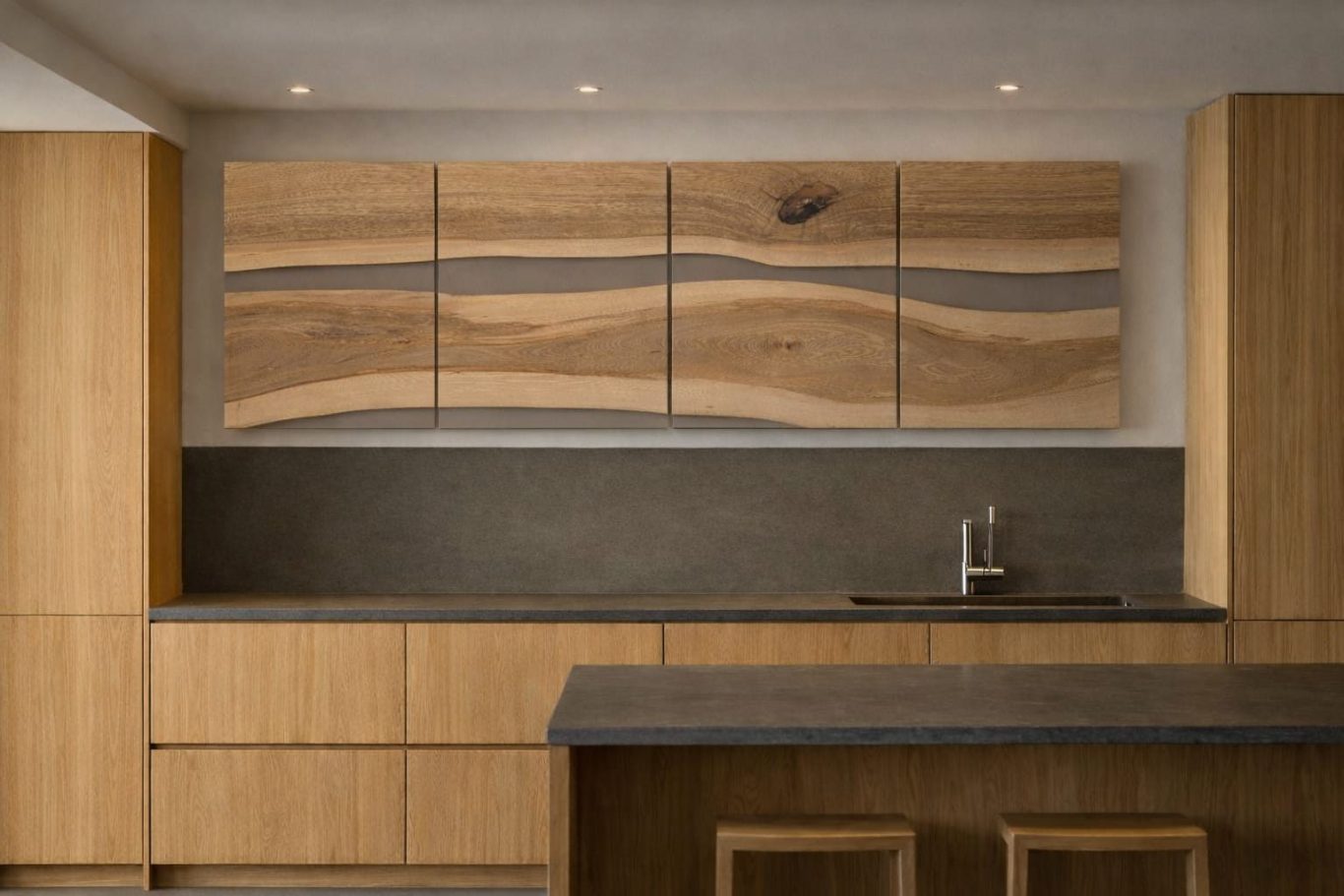
Doors became surfaces, not objects
As cabinetry grew more complex inside, doors became increasingly neutral outside.
They were asked to:
- step back
- repeat
- behave
- stay out of the way
Veneers got thinner.
Patterns became graphic rather than material.
Colour replaced substance.
Doors began to serve the system, not the room.
The result is a familiar feeling:
a kitchen that feels resolved on installation,
but dated far sooner than expected.
The quiet problem: doors are designed for now
Most kitchen doors are designed to:
- suit current tastes
- photograph well
- align with trends
- change easily next time
They are not designed to:
- settle
- deepen
- acquire familiarity
- improve with use
They are designed for now, not for living with.
That isn’t a failure of craftsmanship.
It’s a consequence of priorities.
Furniture ages differently — and there’s a reason
Furniture operates under a different logic.
A table cannot rely on:
- clever internals
- hidden hardware
- interchangeable fronts
It has only:
- proportion
- material
- surface
- touch
As a result, furniture makers learn very quickly where restraint matters and where it doesn’t.
Material is allowed to:
- vary
- move
- carry history
- remain visible
And that is why a well-made table often outlasts multiple kitchens.
What happens when that logic is reversed
Occasionally, furniture-level discipline is applied back onto fixed elements — particularly doors.
When that happens:
- grain is allowed to dominate over pattern
- variation replaces repetition
- surfaces are resolved, not styled
- the door becomes an object, not a skin
The kitchen doesn’t become louder.
It becomes calmer.
And more importantly: it stops belonging to a moment.
This isn’t about rejecting modern kitchens
Modern kitchens are extraordinary achievements.
The ingenuity, tolerances, and coordination involved are remarkable.
This is not a rejection of that world —
it’s a question about what is allowed to last once the ingenuity has done its job.
A quieter alternative
There is another way of thinking about doors:
not as replaceable surfaces
but as furniture-grade elements
made with the same discipline as a table
and allowed to carry time rather than resist it
This approach isn’t faster.
It isn’t cheaper.
And it isn’t common.
But for some kitchens, it changes how the room ages entirely.
Further reading
If you’re interested in how furniture-level material thinking can extend into fixed elements, you can see a reference study here:
This work is shown to explain a way of thinking, not as a standard offering.